
Pakistan’s illegal organ trade forces poorest to act as spare parts for rich: Report
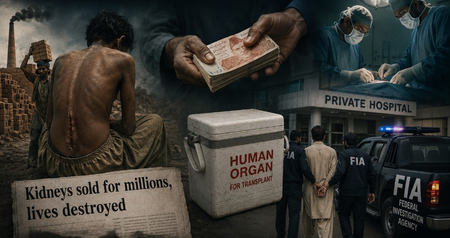
Islamabad, May 24 (IANS) The illegal organ trade in Pakistan, driven by the economic vulnerability of victim “donors” and the greed of both recipients and the doctors involved, continues to present significant challenges as people from the poorest sections of the society continue to “act as spare parts for the rich”.
As Pakistan grapples with a persistent illegal organ trade, the Federal Investigation Agency (FIA) recently raided a prominent private hospital in Islamabad, arresting nine people, including a well-known urologist — exposing the scale of organ trafficking networks.
Although authorities carry out periodic raids and arrests, the illegal kidney trade continues, with numerous victims losing their kidneys, at times without their knowledge or consent.
According to a report in the leading Pakistani daily The Express Tribune, the illegal organ trade continues to pose serious challenges in the country, fuelled by the economic vulnerability of victim “donors” and the greed of recipients as well as the doctors involved in the procedures. It has become a stark example of “forcing the poorest citizens to act as spare parts for the rich.”
“The network busted in Islamabad allegedly lured victims from the impoverished southern Punjab districts of Rahim Yar Khan and Dera Ghazi Khan, exploiting their desperation for paltry sums before selling their kidneys for millions. Making the situation even more horrifying is the fact that the level of exploitation is often much worse — at least these people were paid something,” the report detailed.
It further mentioned that earlier this year, a labourer was kidnapped in Rawalpindi so that his kidney could be stolen and sold for transplantation to a “wealthy foreign patient”.
“That gang ran a sophisticated operation that offered ‘packages’ to clients, mostly from the Middle East, that blended airport pickups and five-star hotel stays with backroom surgeries in residential basements,” it added.
The report highlighted hundreds of cases at brick kilns across the country, where the Pakistani authorities continue to ignore widespread bonded labour and the abuses endured by the “virtual slaves”.
It added that kiln workers are lured with large sums to clear their “debts” in exchange for the vital organ, but are later underpaid. As the time taken to heal limits their earning capacity, many find themselves trapped in the same debt cycle, while the kiln owners pocket most of the money.
Recently, a report in an online magazine, The Diplomat, stated that Pakistan’s illegal organ trade is primarily driven by financial incentives, with victim selection largely shaped by class.
It further mentioned that extreme poverty in the country sustains a persistent supply-demand gap, as individuals in desperate circumstances are often willing to take significant risks in exchange for monetary compensation, particularly when the sums offered for organs appear relatively high.
According to the report, without stronger external enforcement mechanisms and enhanced international cooperation, this “dark trade” is likely to persist in Pakistan.
–IANS
scor/sd/

