
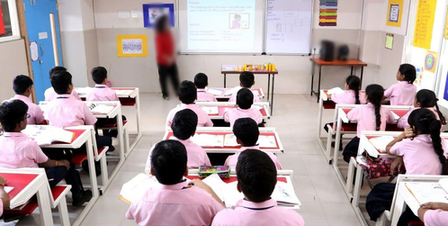
‘Learning by Doing’ initiative gains momentum in Uttar Pradesh, over 500 PM SHRI schools to benefit
Lucknow, Oct 1 (IANS) ‘Learning by doing’, a one of its kind initiative, to educate and engage children in various participatory and practical activities inside the classrooms is gaining momentum across scores of Pradhan Mantri Schools for Rising India (PM SHRI) schools in Uttar Pradesh, with the state government laying emphasis on not just educational mindset but wholesome development of children.
The initiative seeks to take the education beyond the confines of textbooks and expose the children with experimentation, activities, and practical experiences.
Yogi Adityanath-led Uttar Pradesh government has decided to strengthen the ‘learning by doing’ concept in about 586 upper primary and composite PM SHRI schools selected for the academic year 2024-25 and has taken several measures towards its fruition.
“To facilitate this, consumables and raw materials will be procured at a cost of Rs 2.34 crore, with a budgetary limit of Rs 40,000 set for each selected school,” the Uttar Pradesh government said in a press statement.
This initiative will ensure the availability of necessary resources for activity-based teaching in 586 PM SHRI schools, offering children greater opportunities to learn through experiments and hands-on experience alongside textbook-based knowledge.
Speaking about the unique concept in classrooms, Minister of State for Basic Education Sandeep Singh said, “Through ‘Learning by Doing’, the children will get opportunities to learn via experimentation and experience. Our endeavour is to make the learning process engaging, participatory, and aligned with the children’s curiosity.”
Through ‘learning by doing’, students will have the opportunity to understand subject matter via activities, experiments, and direct experiences rather than merely reading about it.
The provided consumables and raw materials will be used to make activity-based teaching effective in schools, enabling children to become active participants in the learning process.
The objective of this initiative is to make the classroom learning process more active and experiential.
Students will be able to grasp subject matter by observing, experimenting, and participating in activities and this is also expected to bridge the gap between textbook knowledge and practical experience while making the learning process more intuitive and engaging.
Besides ensuring optimum usage of materials in schools, the Education department will monitor documentation of activities while emphasis will also be placed on integrating insights gained from previous activities into future initiatives.
–IANS
mr/khz