
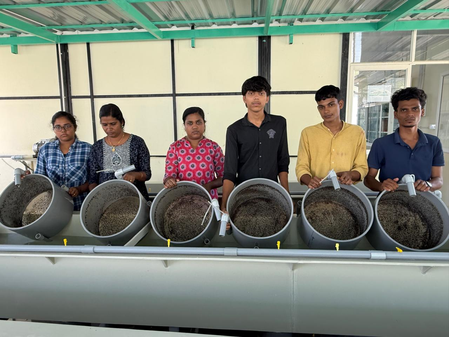
Kerala’s national fisheries institute supplies one million mussel seeds to Maharashtra
Kochi, Oct 24 (IANS) India’s national marine fisheries research institute, ICAR-Central Marine Fisheries Research Institute (CMFRI) at Kochi, in Kerala, has supplied one million hatchery-produced green mussel seeds to Maharashtra in the past six months to promote coastal farming and create alternative livelihood opportunities for fishing and tribal communities.
The latest consignment comprised five lakh seeds, taking the cumulative supply to one million.
CMFRI has also supplied one lakh oyster seeds to the state.
The seeds were produced at CMFRI’s bivalve hatchery at its Vizhinjam Regional Centre in Thiruvananthapuram under the Pradhan Mantri Matsya Sampada Yojana (PMMSY).
The initiative aims to help coastal communities take up mussel and oyster farming using scientifically produced seeds instead of depending entirely on naturally available stocks.
“The initiative is aimed at translating marine fisheries research into livelihood opportunities by promoting sustainable bivalve farming along the Maharashtra coast,” said CMFRI Director Dr Grinson George.
The green mussel seeds measure 2–4 millimetres.
They will be used to develop farming activities with the support of Maharashtra’s Mangrove and Marine Biodiversity Conservation Foundation.
CMFRI has also trained 30 officials of Maharashtra’s Mangrove Cell in nursery rearing and farming techniques for mussels and oysters.
The training was led by a scientific team headed by Principal Scientist Dr M.K. Anil.
The trained officials are expected to help transfer the technology to local communities and provide practical guidance to prospective farmers, Anil said.
Bivalves, which include mussels and oysters, are filter-feeding shellfish that can be farmed in suitable coastal waters.
Their cultivation generally requires limited external inputs once the farms are established, provided water quality and environmental conditions remain favourable.
However, suitable sites, proper monitoring and good farming practices are essential for successful cultivation.
CMFRI’s hatchery technology addresses a key constraint in shellfish farming: the seasonal and location-dependent availability of natural seeds.
A reliable supply of hatchery-produced seeds can help farmers plan cultivation more consistently.
The institute said the combined promotion of mussel and oyster farming could diversify income sources for coastal fishers and tribal communities.
The project is supported by the Union government’s Department of Fisheries.
The initiative also seeks to explore the scope for integrating shellfish farming with mangrove conservation.
The actual livelihood benefits will depend on the adoption of farming practices, survival of the seeds and the market for the harvested produce.
–IANS
sg/uk


