
‘Break the barrier’: Healthy Ministry focused on better access to treatment for childhood cancer
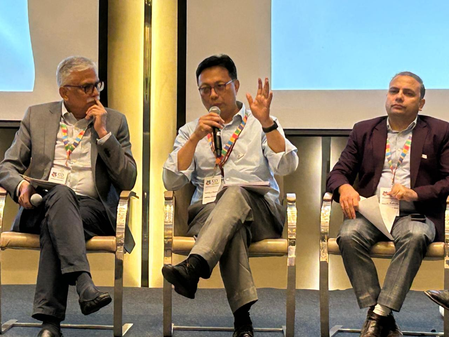
New Delhi, May 21 (IANS) For addressing childhood cancer the Union government is committed to “break the barrier” in such a way that all of them survive, said L. Swasticharan, Deputy Director General of Directorate General of Health Services (DGHS) under Union Health Ministry, here on Thursday.
Speaking at a workshop to shape the roadmap towards a National Childhood Cancer Programme organised by Indian Childhood Cancer Initiative (ICCI), Swasticharan described childhood cancer as the low hanging fruit in terms of government programmes aimed at survival of patients.
“The Non-Communicable Diseases (NCD) programme already has a cancer component. The priority is that a childhood cancer patient should be detected early and ensuring financial support and medical care,” he said.
The Deputy Director General of DGHS, called for learning from models developed by Kerala and Tamil Nadu for involving self-help groups and using financial support models related to Pradhan Mantri Jan Arogya Yojana (PM-JAY).
Swasticharan also stressed on post-survival support for cancer patients.
“All our heroic acts of curing a patient should continue and not end with survival. We need to take up survivor support by engaging community and multi-stakeholder coalitions,” he said.
He added that early detection is of top importance in addressing childhood cancer.
“Setting up a registry for childhood cancer — declaring it a notifiable disease — is an issue. We are still working with ICMR on this. The aim it not to miss any patient,” he said.
Bishnu Giri, Technical Officer (Cancer Control), WHO’s South East Asian Region, said, “Expenditure on childhood cancer is not a fancy or wasteful expenditure, as there is huge monetary gain of $3 from every dollar spent on the disease. The gain is even more in developing nations, apart from social gains.”
He suggested sustainable financing by leveraging flexible sources of funding to improve childhood cancer care and outcomes.
Ramandeep Arora, member of the governing council of ICCI, said that clinical facilities and medical expertise are now available in the country and what is needed is a little help from the government to expand outcomes on the ground.
“A National Childhood Cancer Programme and an MoU with the WHO to make India a partner and focus the country will further bringing in global best practices and technology to the country,” he added.
Abhishek Kunwar, National Professional Officer of NCD at WHO India, said, “We need to learn from the existing NCD programmes and need not have a separate programme for any particular disease.”
He outlined capacity building and task sharing, decentralised care, simple user-friendly information system and cost-effective financing as other focus areas.
Kunwar suggested that all stakeholders need to share their experiences with the government decision makers so that key inputs from them can be woven into the existing health system for better outcomes.
In September 2022, a department-related Parliamentary Standing Committee on Health and Family Welfare in the Rajya Sabha in its 139th Report on ‘Cancer Care Plan and Management: Prevention, Diagnosis, Research and Affordability of Cancer Treatment’, formally acknowledged the need for a dedicated childhood cancer policy framework in India.
Ramandeep Arora, paediatric oncologists at Max Hospital, said the report noted, “The government is in agreement with the view that the Ministry must work towards formulating a National Childhood Cancer Comprehensive Management Policy which involves Early Diagnosis, Shared Care, Integrated Paediatric Oncology Palliative Care across the Public Health Facilities.”
The workshop was organised by ICCI which is a national multi-stakeholder platform launched in 2023 for strengthening childhood cancer care in India through coordinated action, advocacy and policy engagement.
According to ICCI and other studies, an estimated 75,000 new childhood cancer cases are diagnosed annually in India, with a survival rate of around 60 per cent.
–IANS
rch/khz


