
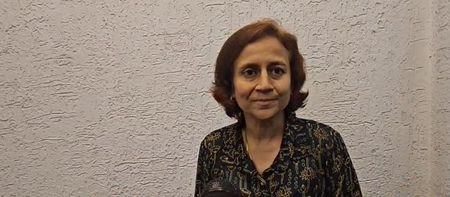
Don’t view language, literature through narrow lens of religious identity; Vande Mataram debate on Hindu deities childish: Sonam Wangchuk’s wife (IANS Exclusive)
Bhubaneswar, Sep 3 (IANS) Gitanjali Angmo, wife of climate activist Sonam Wangchuk, on Thursday said objections to singing ‘Vande Mataram’ on the grounds that it contains references to Hindu deities reflect a ‘childish way of thinking’. She said that language, literature, and cultural expressions should not be viewed through the narrow lens of religious identity.
Speaking to IANS, Angmo said there has been considerable debate and opposition surrounding Vande Mataram, particularly over the argument that people belonging to other faiths cannot sing the national song because it contains references to Hindu Gods and Goddesses.
“So, I think there are a lot of obstructions and objections regarding Vande Mataram. Some oppose it because there are references to Hindu Gods, so they ask how people of other faiths can sing it. So, this is a childish way of thinking,” she said.
Drawing a comparison with Urdu poetry, she said that learning and reciting a ghazal in Urdu does not alter a person’s religious identity.
“So, if we read or learn a ghazal and sing it in Urdu, it is not as if a Hindu singing it would have their religion corrupted. Similarly, if we are reading any shloka or something and associating it with Sanskrit, then that is also very wrong. Sanskrit is a language, so what is the problem?” she said.
Angmo said that references to Hindu deities in Vande Mataram can also be understood symbolically rather than being viewed exclusively through a religious lens.
“There is Durga. Durga stands for power. Lakshmi stands for abundance. So, if anyone has a problem with singing a song, you cannot change it. The first two stanzas were initially chosen because the song was too long. It does not mean that the remaining stanzas were not accepted. You cannot cut any work of art,” she said.
She stressed that Vande Mataram has a deeper cultural and civilisational significance and said that the song has been fading from collective memory more than it should.
“I think Vande Mataram is fading from our collective memory more than it should. Therefore, it needs to be sung and understood again among people, especially among the youth. For me, Vande Mataram is not just a song, but a very profound symbol,” she said.
Referring to Sri Aurobindo’s interpretation of Bankim Chandra Chattopadhyay’s work, Angmo said the idea of the motherland as a living entity was central to the understanding of Vande Mataram.
“Sri Aurobindo also explained this very deeply. When Bankim Chandra Chatterjee wrote ‘Anandamath’, he was not just a novelist; he was a sage. A sage means someone who can see reality. He saw the land of India not just as land, but as a power — as a ‘mother’ with whom we can have a living relationship,” she said.
“Therefore, in my opinion, this awareness should not have taken so long to come. If we had come to this understanding earlier, perhaps many of the problems India faces today would not have been so serious,” she added.
Angmo also welcomed the recent emphasis on Vande Mataram and said that although it has always been India’s national song, it had gradually faded from public and collective memory.
“As a national song, it was always there, but it was fading from collective memory more than it should have. It took 80 years to sing it from the Red Fort on Independence Day, and I think it is a welcome step,” she said.
She again referred to Sri Aurobindo’s interpretation of Bankim Chandra Chattopadhyay and said that the land of India was viewed as “Shakti” rather than merely a geographical territory.
“Mother as a symbol… Sri Aurobindo said that Bankim Chandra Chatterji, when he wrote ‘Anandamath’, was not just a novelist; he was a Rishi (sage). Rishis are seers who can see, so he saw this landmass not as a physical landmass, but as Shakti – a living being. This Mother is a living being with whom you can have a relationship,” she said.
“So it shouldn’t have taken 80 years. Perhaps if we had this awareness earlier, we wouldn’t be facing the problem of India being divided today,” she added.
Asked whether politics has created a sense of division around Vande Mataram and Hindu culture, Angmo said that political agendas can sometimes lead people to distance themselves from their cultural roots in the name of creating unity.
“That’s the problem. When politics enters public life with its agenda, it often attempts to distance individuals or society from their essence in the name of bringing people together. But there’s no need to amputate oneself to bring everyone together,” she said.
“I can reach the essence of who I am and express it, and the other person can also reach their essence and express it — that’s true beauty. If, to please others, I close myself off, silence myself, and prevent myself from expressing who I truly am, that’s not harmony,” she added.
Angmo said that genuine harmony does not mean forcing everyone to become identical. Instead, she argued, society should celebrate differences while ensuring that people respect one another.
“It is a very important principle of collective living. When we talk about harmony, we must understand that harmony doesn’t mean making everyone the same,” she said.
“Socialism says everyone should have equality, and capitalism offers its own unique system. But reality perhaps lies beyond both. When I can truthfully express my deepest self, and you too have complete freedom to express yours, only then can we together create a perfect society,” she added.
Using the example of a jigsaw puzzle, Angmo said that differences between individuals can contribute to creating a stronger and more complete society.
“It’s like a jigsaw puzzle. Each piece is different, but together they form a complete picture. When you go to a botanical garden, not all the flowers are the same. Each flower has a different colour, shape, fragrance and appearance. This diversity is what creates the beauty of a botanical garden,” she said.
She also drew an analogy with agriculture and said that diversity can create synergy.
“Even in agriculture, we know that monoculture isn’t always good. When different plants grow together, like in the Miyawaki forest, synergy is created between them. Similarly, in society, we need diversity that uplifts each other without making everyone equal. We should grow through education to the point where we can respect the unique identity and perspective of others,” she said.
Angmo further highlighted India’s long history of cultural assimilation, saying that the country has absorbed influences from different cultures without necessarily having to abandon its own traditions.
“India has always assimilated influences from outside. Whether it’s Mughal influence or any other cultural influence, India has absorbed and assimilated a lot. But assimilation doesn’t mean we should be ashamed to express our culture that existed ten thousand years ago. We shouldn’t shrink ourselves to accommodate others,” she said.
She cited former President A.P.J. Abdul Kalam as an example of someone who engaged deeply with different streams of Indian thought and said that exposure to another tradition does not necessarily undermine one’s own faith.
“Abdul Kalam used to read the Upanishads, the Gita and Sri Aurobindo. I myself read Sufi poetry. There’s no question of religion being corrupted by this. If a Hindu speaks Urdu or a Muslim speaks Sanskrit, that doesn’t corrupt their religion. Rather, we should learn from each other,” she told IANS.
Explaining what Vande Mataram means to her, Angmo said that the phrase expresses reverence towards the motherland.
“The essence of Vande Mataram is — I bow to you, O Mother. For thousands of years, we have seen this land not merely as territory, but as a mother. Therefore, we cannot let go of that sentiment,” she said.
She said India should simultaneously remain open and inclusive while preserving its cultural heritage.
“We should have a heart big enough to accept everyone, but at the same time, we should also keep our life force, our culture and our heritage alive. This combination can make India a great nation,” she said.
Angmo also argued that the disagreement over Vande Mataram may be more pronounced in political narratives than among ordinary citizens.
“I don’t think there is as much of a problem among common people as there sometimes is in narratives created because of political agendas. Many times, politicians promote a mindset of division for their own agenda,” she said.
“Vande Mataram became a war cry because it inspired. So, you can’t negate it due to polarisation. You will have to accept it,” she added.
Addressing the argument that the country should focus on issues such as poverty and unemployment instead of placing emphasis on Vande Mataram, Angmo said that the two issues should not be viewed as competing priorities.
“Because this question of Vande Mataram versus other problems is wrong. If I have to do my job, build my career and work for my livelihood, that doesn’t mean I have to leave my mother behind,” she said.
According to Angmo, what is needed is a broader shift in people’s approach towards their responsibilities as citizens.
“Today, a major mental shift is necessary within us — from ‘What can India do for me?’ to ‘What can I do for India?’ This shift is crucial. When we only think about what the country will give us, our perspective becomes one of taking. But when we ask what I can give to the country, then nation-building begins,” she said.
She said poetry, literature and mantras that evoke a sense of belonging can serve as sources of inspiration for citizens to contribute towards addressing the country’s challenges.
“The purpose of high poetry and high mantras isn’t just to make us emotional. They inspire us, awakening a greater purpose within us. If we have this feeling for our country, we can fight poverty, unemployment and other problems with more energy,” she said.
“Therefore, saying, ‘Why Vande Mataram, when there are other problems?’ isn’t the right framing. Vande Mataram isn’t against other problems. Vande Mataram is a sentiment that inspires us to fight those problems,” Angmo added.
“When we develop the feeling that this country is mine and I have to make it better and hand it over to the next generation, then nation-building isn’t just the government’s responsibility — it becomes the responsibility of every citizen,” she said.
–IANS
jk/dpb


