
Haryana-based gang busted after tricking woman in Rs 55 lakh ‘digital arrest’ scam
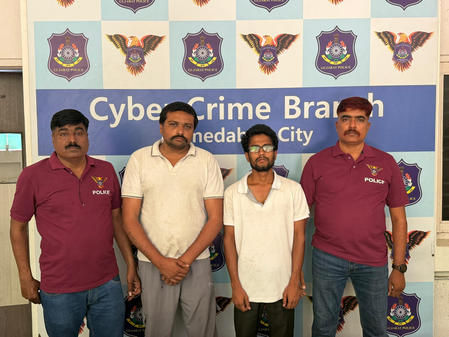
Ahmedabad, May 12 (IANS) The Ahmedabad Cyber Crime Branch has arrested two members of an interstate cyber fraud gang involved in a “digital arrest” scam in which a senior citizen woman was cheated of Rs 55.50 lakh after being impersonated and coerced through fabricated legal threats and forged official communications.
According to police, the case was registered at Cyber Crime Police Station under various sections of the Bharatiya Nyaya Sanhita, 2023, including Sections 338, 336(3), 340(2), 341(1), 318(4), 319(2), 204, 205 and 3(5), along with Sections 66(C) and 66(D) of the Information Technology Act.
The complainant was contacted via a WhatsApp video call by unknown individuals who falsely identified themselves as “Ranveer Singh” from Colaba Police Station, Mumbai.
They informed her that she was allegedly involved in a fraud case and claimed that a warrant had been issued against her.
The callers further asserted that she had been placed under “digital arrest” for one month and would be produced before a court.
Police said the accused bolstered their deception by sending fabricated documents, including fake FIR details purportedly issued by the Mumbai Crime Branch, forged letters in the name of the Finance Ministry’s Department of Revenue, and false references to the Supreme Court of India.
Under the guise of verifying whether the complainant’s assets were proceeds of crime, they obtained her bank details and coerced her into transferring funds and taking a gold loan.
In total, Rs 55,50,094 was transferred through multiple online transactions under sustained intimidation and psychological pressure.
An officer from the Cyber Crime Branch said, “The accused impersonated law enforcement officials and used forged documents to create fear and convince the victim that she was under legal custody. It was a coordinated conspiracy aimed at extracting money through digital fraud.”
Investigations revealed that the fraud was carried out through a pre-planned network involving multiple operatives.
The accused were traced to Haryana and subsequently arrested.
They have been identified as Sonu Kumar, a resident of Gurugram, Haryana, and Pradeep Kumar, a resident of Salapur Kheda, under Kapashera police station limits in Delhi.
Police said Sonu Kumar had opened a bank account in the name of M/S QUIKDY TECHNOLOGIES PRIVATE LIMITED with ICICI Bank and shared its credentials with the co-accused.
Both have also alleged that they met an associate, identified as Wasim Khan, at a hotel in Friends Colony, Lajpat Nagar, Delhi, where they coordinated transactions and facilitated fraudulent fund transfers.
“Both met Khan at a hotel in Delhi, stayed there for two days, and facilitated transactions worth Rs 1,73,75,030,” officials said.
Investigators said Sonu Kumar derived personal financial benefit from the proceeds. Pradeep Kumar was found to be in regular contact with cyber fraud operatives and played a role in routing funds through multiple accounts.
Police said he obtained bank details from Sonu Kumar, facilitated transactions through accounts linked to the gang, and also gained financially from the operation.
Investigators further stated that bank accounts linked to the accused were associated with seven cyber complaints registered across Maharashtra, West Bengal, Gujarat, Delhi, and Uttar Pradesh on the coordination portal.
The accounts were allegedly used in a structured manner to receive and transfer proceeds of crime.
Among the identified accounts were ICICI Bank and other accounts linked to M/S QUIKDY TECHNOLOGIES PRIVATE LIMITED, along with multiple transaction references recorded across various states.
Police said the gang operated by impersonating police and central agencies, using fear-based tactics, fake arrest threats, forged FIRs, and fabricated judicial documents to intimidate victims and extract money.
Authorities have reiterated that no law enforcement agency conducts arrests through video calls or demands OTPs, PINs, or online transfers during investigations.
Citizens have also been advised not to install remote access applications such as AnyDesk, TeamViewer, or QuickSupport in response to instructions from unknown callers, as these are commonly used in cyber fraud operations.
–IANS
mys/dan


