
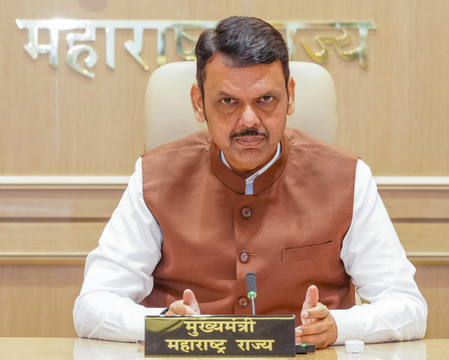
Maha govt forms task force to shape comprehensive transit network under ‘Viksit Maharashtra 2047’
Mumbai, Oct 15 (IANS) In a major step towards modernising urban mobility, the Maharashtra government has issued a Government Resolution (GR) to establish a high-level Task Force, which will draft a comprehensive framework for expanding railway networks, metro corridors, and Regional Rapid Transit Systems (RRTS) across the Mumbai Metropolitan Region (MMR) and other urban areas in the state.
The initiative aligns with the ‘Viksit Maharashtra 2047’ vision, which aims to plan and expand transit networks more effectively and systematically. The formation of the Task Force follows a high-level meeting held on October 7, under the chairmanship of the Additional Chief Secretary (Urban Development-1).
The newly established task force has been mandated to deliver its strategic recommendations and report within six months. Its core responsibilities include the formulation of policy recommendations and coordination measures to ensure seamless integration of public transit networks under the Viksit Maharashtra 2047 goals, conducting deep assessments regarding feasibility, suitability, and economic viability to determine which transport systems should be deployed in specific regions and the evaluation of the expansion of railway networks, the implementation of metro corridors, RRTS, and connecting major cities via semi-high-speed rail.
The task force comprises key leaders and planning chiefs from major infrastructure and urban development bodies.
Chaired by the Chairman and Managing Director, Mumbai Railway Vikas Corporation (MRVC), the Chief Manager (Planning), Mumbai Railway Vikas Corporation (MRVC), will be the member secretary. The task force’s members include Joint Secretary (UD-7), Urban Development Department; Director (Planning/Projects), Maharashtra Metro Rail Corporation Ltd. (Maha-Metro), Nagpur; Director (Projects), Maharashtra Metro Rail Corporation Ltd. (Maha-Metro), Pune; Director (Planning), Mumbai Metro Rail Corporation Ltd. (MMRCL), Mumbai; Head (Transport & Communications), Mumbai Metropolitan Region Development Authority (MMRDA), Mumbai.
The invitees (Planning Department Heads) include the representatives from CIDCO (Navi Mumbai), Pune Metropolitan Region Development Authority, Nashik Metropolitan Region Development Authority, Chhatrapati Sambhajinagar Metropolitan Region Development Authority, Nagpur Metropolitan Region Development Authority, and Maha Mumbai Metro Operation Corporation Limited.
The task force chairman is also empowered to invite additional members as necessary for deliberations.
The transit network in the Mumbai Metropolitan Region (MMR) comprises a massive, multi-modal public transport system that serves millions of daily commuters. It is anchored by the historic suburban railway grid, rapidly expanding metro lines, and feeder systems.
Spanning over 435 km, Mumbai’s suburban rail network is one of the oldest and busiest in Asia, carrying roughly 7.5 million passengers daily. It is structured mainly across three primary trunk routes — the Western Line, Central Line, and Harbour Line — extending from South Mumbai deep into the extended suburbs and neighbouring districts.
The network continues to undergo capacity upgrades, station improvements, and rolling stock modernisation (including widespread introduction of air-conditioned local train services) managed by the Central Railway, Western Railway, and other bodies, such as the Mumbai Railway Vikas Corporation (MRVC).
The Mumbai Metro network has seen substantial operational growth, scaling up to an operational length of roughly 80 km across key intersecting corridors. Line 1 (Blue Line): Versova to Ghatkopar (11.4 km, fully elevated, operational since 2014) while Line 2A (Yellow Line): Dahisar East to Andheri West (18.6 km), Line 7 (Red Line): Dahisar East to Gundavali (16.5 km) are operational and Line 3 (Aqua Line): Cuffe Parade to Aarey Colony (33.5 km, fully underground, completed in phases through late 2025, serving major commercial hubs like BKC and the airport).
Daily metro ridership has scaled past 1.6 million passengers, providing vital east-west and north-south links that complement the traditional north-south bias of the suburban rail network.
Over 120 km of additional metro tracks are currently in various phases of construction or approvals (including Line 2B, Line 4/4A Green Line, Line 5, Line 6, and extensions like Lines 9 and 12) to interconnect Thane, Navi Mumbai, Kalyan, and Mira-Bhayander.
A single monorail corridor operates in pockets of the city, though its integration and service reliability have faced historic bottlenecks. Extensive municipal and state transport bus fleets (BEST, TMT, KDMT, NMMT) serve as critical first- and last-mile connectors to railway and metro stations.
–IANS
sj/dpb


