Pak tried to trigger communal tensions but Indians foiled plan by seeing through their evil design: Gen Bakshi (IANS Exclusive)
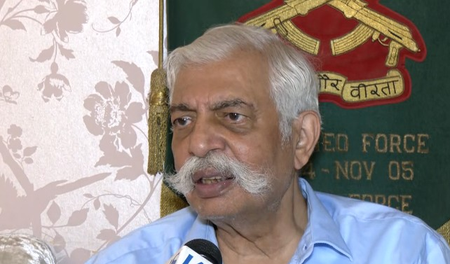
New Delhi, Aug 4 (IANS) Major General (Retd.) G.D. Bakshi has alleged that Pakistan’s strategy behind recent terror attacks is to incite communal unrest in India by selectively targeting victims based on their religion. Referring to the terror attacks in Pahalgam and Kulgam, the former Army officer said the objective was to provoke retaliatory violence, disrupt peace in Jammu and Kashmir, and damage the region’s economy by hurting tourism. However, Indians saw through Islamabad’s evil designs and maintained peace.
In an interview with IANS, Maj Gen Bakshi said, “The message they were trying to convey in Pahalgam. What they were trying to do in Pahalgam was as per a very ulterior design of the ISI sanctioned by Field Marshal Asim Munir. He ordered them to ask the people their religion before shooting them, so that riots start in India against the Kashmiris, against the Muslims. He aims to instigate riots and anger in India by selective killing based upon religion, so that you create religious riots in India. You create riots against the Kashmiri people who will be singled out for such retaliatory attacks in India; that was their hope.”
He, however, said that the alleged strategy did not succeed because people across the country understood the intent behind the attacks.
“However, the Indian people showed tremendous intelligence in seeing through this design and the Kashmiri people understood that this was to try and get them murdered, to stop the tourism, economic gain that they get from tourism. So many livelihoods in J&K are dependent upon tourism. That is what they (Pakistan) were trying to stop,” he said.
The retired Army officer also warned that Pakistan should not assume that India’s military response had ended with Operation Sindoor. According to him, any renewed terrorist activity would invite a much stronger response from India.
“We will not just defend, we will not just go defending every little target everywhere all over the valley, which is impossible… But we can give it back to you across the Line of Control, across the International Border. As you saw in Operation Sindoor; that was just a trailer… If Pakistan has a death wish, it will provoke India, then it will be doomed… It is a country whose economy is on the verge of ruin, collapse,” Bakshi said.
Commenting on the possibility of resuming dialogue with Pakistan, Maj Gen Bakshi dismissed such suggestions and reiterated India’s long-standing position that talks and terrorism cannot proceed simultaneously.
“Continuing terror attacks, including what you saw over the last 2-3 days in J&K, how can terror and talks go together, how can blood and water flow together? The Prime Minister had made it crystal clear — blood and water cannot flow together,” he said, referring to India’s decision to suspend the Indus Waters Treaty (IWT).
The Army veteran also criticised the circumstances under which the Indus Waters Treaty was originally signed, arguing that it was based on the expectation of peaceful relations with Pakistan.
“We must understand the backdrop; the simple fact is in 1956, Pandit Nehru, you know, signed this treaty with Pakistan, you know, it was an absolutely unequal treaty. But he signed it in the hope that he would gain Pakistan’s friendship and goodwill. It would end the Kashmir dispute, and Pakistan would be reassured that India meant well,” he said.
Questioning the continued relevance of the agreement, he added, “Why did India sign this treaty? Because we thought there would be peace with Pakistan. Was there peace with Pakistan? No! Pakistan attacked India in 1965, 1971, Kargil, and then for 40 years it has waged asymmetric warfare, created mass casualty terror strikes in India. After last year’s April 22 attack, India said enough is enough; blood and water cannot flow together. The whole treaty was negotiated for peace and goodwill and friendship; however, Pakistan has destroyed that by persistent terror attacks on India. You expect us to continue with this most unequal treaty?”
Maj Gen Bakshi further ruled out any role for third-party mediation in matters concerning India and Pakistan, including the Indus Waters Treaty. While he maintained that the treaty could be renegotiated, he insisted that any future discussions must take place directly between the two countries.
“The IWT has to be well renegotiated; however, India will not accept the World Bank or America as our interlocutor now; you (Pakistan) will have to talk directly to us. And all this nonsense about we are going to attack India, you try,” he said.
He also questioned Pakistan’s management of its own water resources, saying, “Why are you (Pakistan) not desilting your barrages? Why are they letting their water flow in the ocean? Then you are criticising India for having no water?”
Rejecting the idea of international involvement, Maj Gen Bakshi added, “What locus standi does America or any other country have to intervene in this problem? It is a bilateral problem; it has to be settled bilaterally.”
Taking aim at what he described as a double standard in international discourse, the retired Army officer remarked, “America is an upper riparian with Mexico. Look at the way it has treated Mexico; they said no question of sharing, sharing, get lost, no international treaty, no nothing. That is America’s attitude. While for India, we must give 80 per cent of our water to the lower riparian?… I mean, you have restricted the waters of Mexico, so there is one set of rules for America, and another for India?”
The retired Army officer said that there shouldn’t be any talks with Pakistan until the cross-border terrorism stops and slammed the Indian politicians who advocated for it.
“Pakistan is facilitating repeated attacks against India; asymmetric war, terrorism and then these few people here, Farooq Abdullah’s son, Mehbooba Mufti, all are calling for talks with Pakistan. What locus standi does Pakistan have on Kashmir? Maharaja Hari Singh had given every region of J&K to India, legally. The entire PoK, Gilgit Baltistan, everything is ours,” he added.
–IANS
sd/rad